
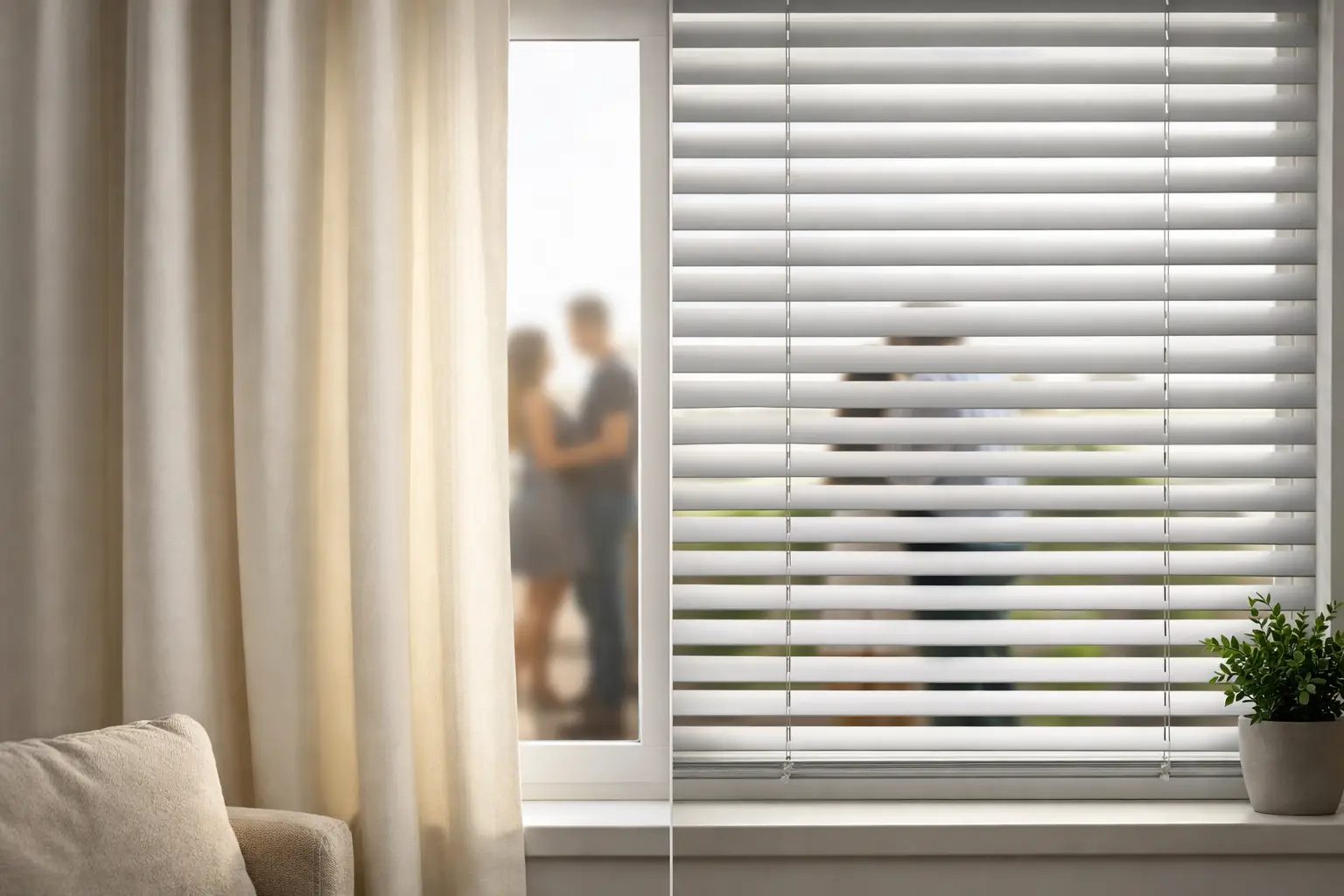
Privacy gets tested at the worst times – when your living room lights are on at night, when your bedroom window faces a nearby block, or when you realize your beautiful window treatment still leaves silhouettes visible. That is why curtains vs blinds privacy is not just a style question. It is a daily comfort question.
For most homeowners, the better choice depends on what kind of privacy you need, how much light you want to keep, and how your room is used. Curtains often give fuller coverage and a softer look, while blinds offer cleaner lines and more control over light during the day. The right answer is rarely one-size-fits-all.
Curtains vs blinds privacy: the real difference
The main privacy difference comes down to coverage and adjustability. Curtains hang as continuous panels, so when they are fully closed, they usually cover the entire window area with fewer gaps. That makes them strong performers for full privacy, especially at night when indoor lighting makes interiors easier to see from outside.
Blinds work differently. They are fitted closer to the window frame and use slats or solid material to block or filter light. This gives you more precise control, but it can also create small gaps at the sides or between slats, depending on the blind type and installation. In practical terms, blinds can be very private, but not every blind gives the same level of screening after dark.
If your top concern is stopping outside views into a bedroom, curtains usually have the edge. If your concern is balancing privacy with daylight in a living area or study, blinds often feel more flexible.
When curtains give better privacy
Curtains are usually the stronger option when complete visual coverage matters. In bedrooms, they can reduce side gaps better than many inside-mounted blinds, especially if they are hung wider and higher than the window frame. That extra overlap matters more than many people expect.
Fabric choice also changes the result. Sheer curtains soften light but do very little for privacy at night. Dim-out and blackout curtains are much better if the goal is to block visibility from outside. Heavier fabrics also help windows feel more sealed off, which can make a room feel calmer and more restful.
This is one reason curtains are popular in sleep spaces. They do not just improve privacy. They can also support darkness, reduce glare, and make the room feel softer. For homeowners furnishing a full bedroom, curtains often pair naturally with other comfort-first decisions.
There are trade-offs, though. Curtains take up more visual space. In compact rooms, especially where every inch counts, they can feel bulkier than blinds. They also need enough wall clearance, which may not work as well near built-in furniture, study desks, or narrow window layouts.
When blinds make more sense
Blinds are often the practical winner when you want privacy without losing all your daylight. In kitchens, bathrooms, home offices, and living rooms, that control can be very useful. You can tilt venetian slats to limit direct sight lines while still letting in some natural light, or lower roller blinds partway depending on the sun angle and neighboring buildings.
Blinds also suit cleaner, more modern interiors. They sit close to the window, look more streamlined, and usually take up less room visually. In condos and apartments where windows are placed close to furniture, this can be a major advantage.
But not all blinds perform equally for privacy. Venetian blinds let you adjust the angle, but unless closed tightly, they may still allow visibility from certain directions. Roller blinds give more continuous coverage when lowered, but side gaps can remain. Combi blinds can be stylish and useful for light filtering, yet privacy depends on how the layers are aligned and whether the fabric is sheer or opaque.
That is why homeowners sometimes feel disappointed after choosing blinds based on appearance alone. A blind can look neat in daylight and still feel exposed at night if the material or fit is wrong.
Day privacy and night privacy are not the same
This is where many buying decisions go off track. A window treatment that feels private during the day may not deliver the same result at night.
During the day, if it is brighter outside than inside, sheer materials and partially open blinds can still give a reasonable sense of privacy. People outside may struggle to see in clearly. Once the sun goes down and your interior lights are on, the situation flips. Your room becomes more visible, and any gaps, translucent fabric, or loosely adjusted slats become much more obvious.
For night privacy, curtains with opaque fabric usually perform best. For blinds, full blackout roller blinds or tightly fitted options tend to do better than slatted designs. If privacy after dark is your highest priority, it is smart to test your choice against nighttime conditions rather than showroom lighting.
Best option by room
Bedrooms usually benefit most from curtains, especially if you want sleep-friendly darkness and dependable privacy. Blackout curtains are often the safer pick for master bedrooms, kids’ rooms, and guest rooms facing neighboring homes or busy streets.
Living rooms are more mixed. If you want softness, warmth, and better nighttime cover, curtains work well. If you want a cleaner look and more daytime light control, blinds may be the better fit. Many homeowners also like layering, with blinds for daytime function and curtains for softness and fuller coverage.
Bathrooms need a material that handles moisture well, so blinds often make more practical sense. Privacy still matters, but fabric curtains used directly at the window may not always be ideal in humid conditions.
Home offices depend on your setup. If glare control is a big issue, blinds can be more precise. If the room doubles as a guest room or sits close to neighboring windows, curtains may feel more secure.
Curtains vs blinds privacy for small homes
In smaller homes, privacy and space planning often have to work together. A treatment that solves one problem but creates another is not really a win.
Blinds often suit compact layouts because they stay close to the glass and do not crowd the room. This can help in apartments where windows sit near beds, wardrobes, or sofas. Roller blinds in particular can feel tidy and efficient.
Curtains can still work beautifully in small spaces, but the details matter. Choosing the right fabric weight, heading style, and mounting width can keep them from feeling heavy. In some cases, ceiling-mounted curtains can even make a room feel taller, which is a useful visual trick in tighter layouts.
For homeowners trying to furnish an entire home on a practical budget, this is often the smartest approach: pick based on room function, not one matching solution for every window. That mindset usually delivers better privacy and better value.
If you want the best of both, layer them
If you do not want to choose between flexibility and full coverage, layering is often the strongest answer. A blind handles daylight control and daytime privacy. A curtain adds softness, better edge coverage, and stronger night privacy.
This combination costs more than using one treatment alone, so it is not always the first choice for every room. But for main bedrooms and living rooms, it often gives the most complete result. It also makes the space feel more finished.
Retailers that work with real homeowners every day, including Catnap Lair, often see this pattern. People start by asking which is better, then realize the better question is where each option works best.
So which should you choose?
Choose curtains if privacy is your top priority, especially for bedrooms and nighttime use. Choose blinds if you want a cleaner look, tighter fit, and easier light adjustment during the day. If you want both comfort and control, layering usually gives the strongest overall result.
The best window treatment should make your home feel easy to live in. Not just stylish when guests visit, but comfortable when the lights are on, the curtains are closed, and you are finally ready to relax.