You can feel the wrong mattress within minutes. If your back is fine but your body still runs hot, the issue is often not firmness – it is the surface and core materials trapping heat. That is why a proper cooling mattress materials review matters before you buy, especially if you already know you sleep warm, share a bed, or live in a climate where nights do not cool down much.
A lot of mattresses are marketed as cooling, but not all cooling features do the same job. Some materials help heat leave the surface faster. Some improve airflow through the mattress. Others mainly delay heat buildup for the first hour or two. The difference sounds small until you are waking up sweaty at 3 a.m. and wondering why the showroom mattress felt better than the one at home.
Cooling mattress materials review: what actually changes sleep temperature
When people talk about a mattress sleeping cool, they usually mean one of three things. The surface feels cool when you lie down, the mattress stays more temperature-neutral through the night, or it lets enough airflow through that your body heat does not get trapped. Those are related, but they are not identical.
This is where many buyers get confused. A mattress can feel cool at first touch because of the cover fabric, then warm up fast because the comfort layers below hold heat. Another mattress may not feel icy at first, but it stays more stable over several hours because the core allows better ventilation. If you are comparing options, look beyond the label and ask which part of the mattress is doing the cooling.
Cooling covers and phase-change fabrics
The cover is the first thing your body touches, so it has an outsized effect on first impressions. Cool-touch fabrics and phase-change materials are designed to pull heat away from the skin quickly. They can make a mattress feel noticeably fresher when you first lie down.
That said, covers are usually a surface-level solution. They help with initial comfort, but they cannot fully overcome a heat-retentive interior. If the layers underneath are dense and slow to ventilate, the mattress may still sleep warm after some time. A cooling cover is best viewed as a useful bonus, not the whole cooling story.
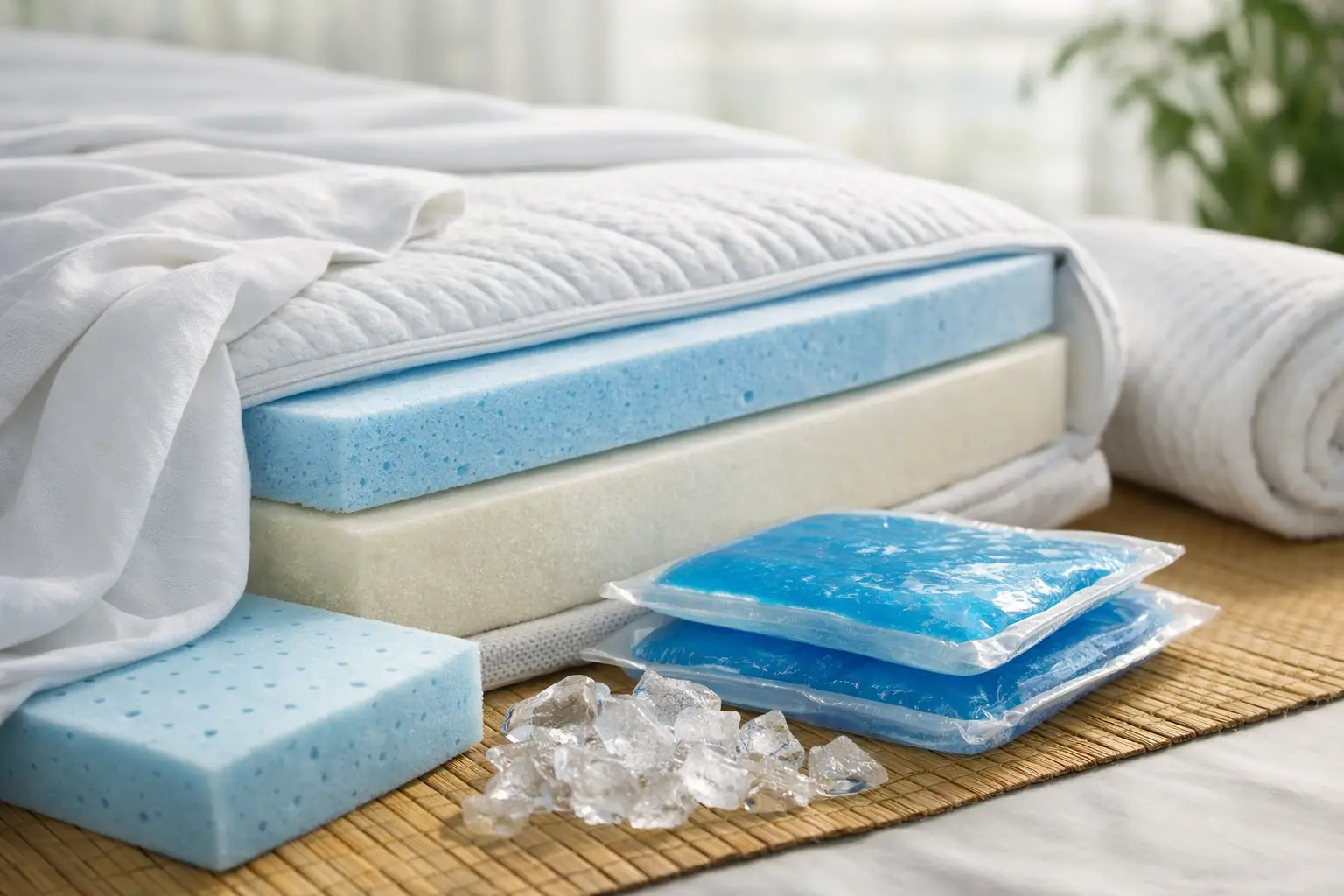
Gel memory foam
Gel memory foam is one of the most common cooling claims in the market. The idea is straightforward – adding gel can help disperse heat more efficiently than traditional memory foam. In practice, this can improve temperature regulation somewhat, especially compared with older, denser foams.
Still, the trade-off is real. Memory foam, by nature, contours closely and allows more body sink. That hug can reduce airflow around your body, which is why even gel-infused versions may still feel warmer than latex or coil-forward designs. If you love pressure relief and motion isolation, gel memory foam can be a reasonable middle ground. If you are a very hot sleeper, it may not be the coolest option available.
Open-cell and copper-infused foams
Open-cell foam is engineered with a structure that allows more air movement than conventional closed, dense foam. Copper-infused foams are also marketed for thermal conductivity, with the goal of moving heat away from the sleeper more effectively.
These materials can be improvements over standard foam, but expectations should stay realistic. They usually perform best as part of a broader mattress design that includes breathable covers and supportive base layers. On their own, they do not turn an all-foam mattress into the coolest category on the market. They simply make foam less heat-prone.
Which cooling mattress materials perform best over a full night?
If your priority is sustained cooling rather than a quick cool-touch effect, latex and innerspring or hybrid constructions usually stand out. They solve the problem differently, but both tend to create more airflow than dense foam-heavy beds.
Natural and synthetic latex
Latex has a more buoyant feel than memory foam, so you tend to sleep more on the mattress rather than deeply in it. That matters for heat. Less sink generally means more room for air to circulate around the body. Many latex layers are also pinholed or aerated, which further helps ventilation.
The trade-off is feel and price. Latex is responsive and supportive, but some sleepers do not like its springier sensation compared with the deep cradle of memory foam. Natural latex can also raise the cost of the mattress. For hot sleepers who want durability and a more breathable comfort layer, though, latex is often one of the strongest choices.
Pocketed coils and hybrid builds
Coils are naturally good for airflow because there is simply more open space inside the mattress. In a hybrid mattress, a coil support core paired with moderate comfort layers often creates a better balance of cooling, support, and pressure relief than thick all-foam construction.
This is why many cooling-focused mattresses use pocketed coils under foam or latex comfort layers. You still get cushioning, but the core is less likely to trap heat. For couples, hybrids also offer a practical compromise. They usually sleep cooler than all-foam beds while still controlling motion better than old-style connected spring mattresses.
Fiber fills and quilted tops
Some mattresses use breathable fibers such as cotton, wool blends, or other quilting materials near the surface. These can help with moisture management and add a less heat-retentive top feel compared with thick foam padding.
They are most effective in moderation. A quilted top can improve comfort and airflow, but if too much plush filling is stacked on top, especially with softer foams beneath, cooling performance may still drop. As always, material combinations matter more than any single buzzword.
Cooling mattress materials review by sleeper type
The best material depends partly on how you sleep. A side sleeper with shoulder pressure needs something different from a back sleeper who mainly wants airflow and lumbar support.
If you are a side sleeper, very firm and highly ventilated surfaces may not be enough on their own. You still need pressure relief at the shoulders and hips. A hybrid with breathable foam or latex comfort layers often works well because it balances contouring with airflow. An ultra-thin comfort layer may sleep cool but feel too hard.
If you are a back sleeper, you often have more flexibility. Latex, hybrids, and firmer gel foam mattresses can all work, provided the surface keeps your spine aligned without excessive sink. Since back sleepers usually have more body contact spread evenly, surface heat buildup can be less extreme than for stomach or deep-sinking side sleepers.
If you are a stomach sleeper, avoid overly plush memory foam if heat is a concern. Too much sink can wrap around the midsection and trap warmth. More responsive materials like latex or a firmer hybrid tend to feel cooler and more supportive.
For couples, cooling should be judged together with motion isolation and edge support. Some very breathable mattresses transfer more movement, while some excellent motion-isolating foams sleep warmer. The better choice is usually the one that gives you enough cooling without creating a new problem in partner disturbance.
What marketing terms often mean in a cooling mattress materials review
A few common phrases show up again and again in mattress shopping, and they are worth reading carefully.
“Cool-touch” usually refers to the cover. It can be pleasant, but it does not guarantee all-night temperature control.
“Gel-infused” means there is some gel integrated into the foam, not that the entire mattress has strong airflow. It may help, but results vary by foam density and thickness.
“Breathable” is broad. Nearly every brand uses it. The real question is which layer is breathable and how much of the mattress relies on that layer.
“Hybrid cooling” often has more substance because it usually points to a coil core, and coils genuinely improve ventilation. Even then, a very thick foam top can reduce the benefit.
This is one reason practical guidance matters more than flashy wording. At Catnap Lair, the better approach is to match the material mix to how a real household sleeps, not just to whichever cooling label sounds best on a product page.
How to compare mattress materials without overcomplicating it
If you want the simplest rule, start with construction before extras. A breathable cover is helpful, but the bigger difference often comes from whether the mattress is all foam, latex, innerspring, or hybrid.
For the coolest overall feel, many sleepers do well with latex or hybrid mattresses that have pocketed coils and moderate comfort layers. For a softer, more contouring feel with some temperature improvement, gel or open-cell foam can still make sense. For buyers who mainly want that cold-on-contact sensation, pay attention to the cover, but do not stop there.
It also helps to be honest about the rest of your setup. Mattress protectors, thick bedding, and non-breathable sheets can cancel out some of the benefits of cooling materials. Sometimes the mattress is only part of the issue.
The most useful mindset is not asking, “Which material is best?” It is asking, “Which material gives me the right balance of cooling, support, and comfort for how I actually sleep?” That question usually leads to a better purchase than chasing the coldest showroom feel. A cooler night starts with the right materials, but the right choice is the one you will still be happy with long after the first touch test.