A dining table can look perfect in a showroom and still feel completely wrong once it lands in your home. That usually happens for one reason: the size was chosen by eye instead of by layout. If you’re wondering how to choose dining table size, the goal is not just fitting a table into the room. It is making sure people can sit comfortably, move around easily, and use the space every day without frustration.
For most homeowners, especially those furnishing apartments, condos, or family homes with tighter layouts, this decision affects more than aesthetics. The dining area often doubles as a work spot, homework station, hosting zone, or even extra kitchen prep space. A table that is too large can make the room feel cramped. Too small, and it stops being practical the moment guests come over.
How to choose dining table size starts with your room
The first measurement to care about is not the table. It is the open space around it.
A common mistake is measuring wall to wall and assuming any table smaller than that number will work. In real life, chairs need space to pull out, and people need clearance to walk past. As a simple rule, leave about 36 inches between the edge of the table and the wall or any large furniture. If your layout is tighter, 30 inches can still work in a compact home, but it will feel more snug.
This is why floor planning matters. A 72-inch table may technically fit in a dining area, but if the chairs hit the sideboard every time someone sits down, it is not a good fit. Measure the usable area, not just the room itself. If you have a kitchen island nearby, a swing door, or a walkway to the living room, those all count.
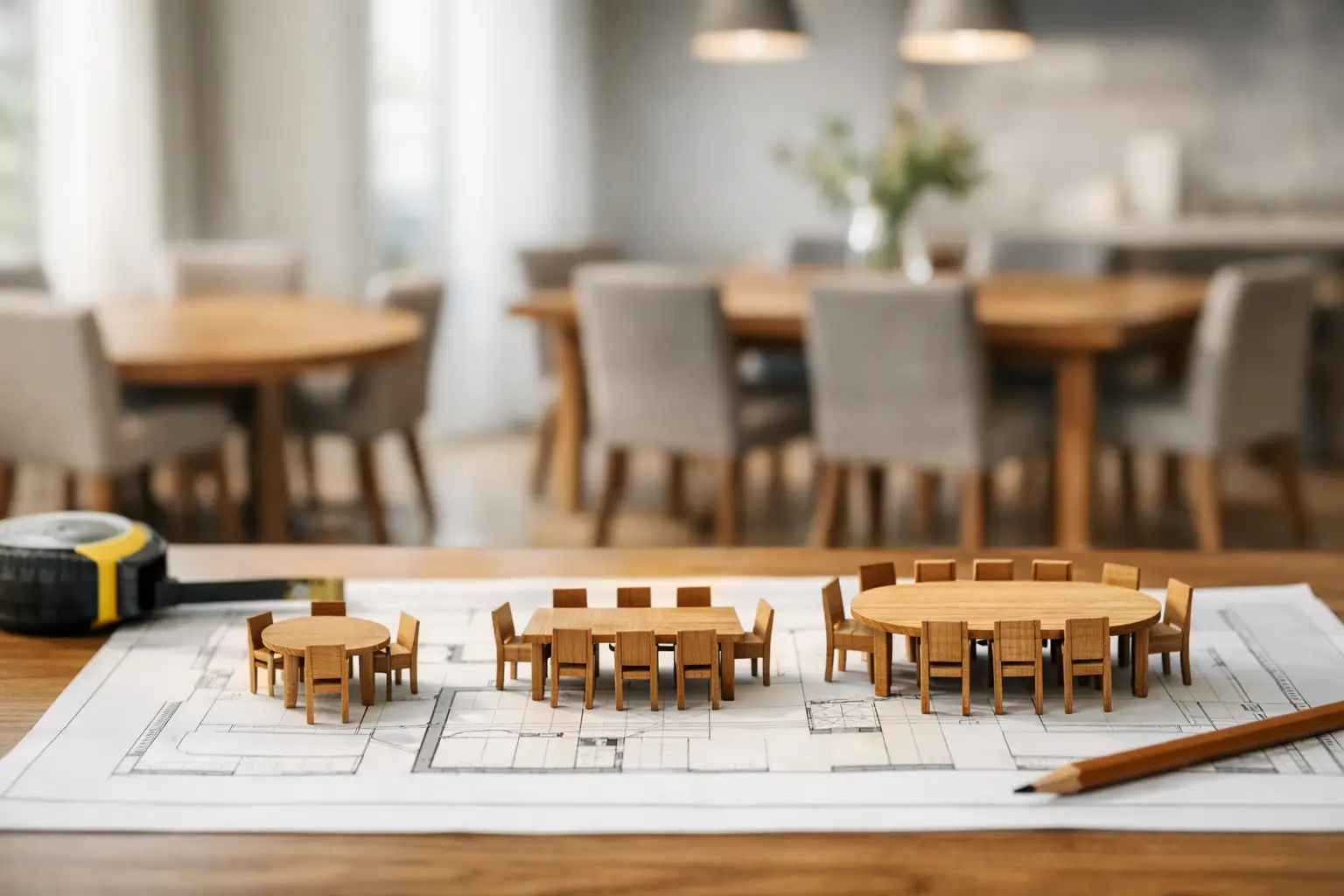
A practical way to visualize this is to tape the table dimensions on the floor. It sounds basic, but it helps immediately. You can walk around the outline, pull out an imaginary chair, and get a much clearer sense of whether the size feels comfortable.
Match the table size to how you actually eat
The next step in how to choose dining table size is being honest about daily use. Buying only for the occasional holiday dinner often leads to a table that overwhelms the room for the other 360 days of the year.
Start with your usual headcount. If you are a couple who occasionally hosts parents, your ideal table size may be different from a family of five who eats together every night. Think about regular use first, then occasional extension second.
As a rough guide, each seated person needs around 24 inches of table width. That gives enough elbow room for a comfortable meal without everyone feeling squeezed together. For table depth, 36 to 42 inches is usually the sweet spot. It leaves enough space for plates, serving dishes, and shared food while keeping conversation easy across the table.
If you need quick reference points, a 48-inch round table usually seats 4 well. A 60-inch round table often seats 6. A rectangular table around 60 inches long typically seats 4 to 6, while 72 inches is better for 6 to 8 depending on chair width and leg placement.
Those numbers are useful, but they are not fixed rules. Chair size, pedestal versus corner legs, and whether you use armchairs at the ends can all change the real seating capacity.
Shape changes everything
Many people focus only on length, but table shape has just as much impact on how a dining area feels.
Rectangular tables are the most common choice because they work well in long or open-plan spaces and generally seat more people for the footprint. If your dining area is narrow, a rectangular table is usually the easiest option to place without wasting space.
Round tables are excellent for smaller households and square rooms. They soften the room visually, improve conversation, and remove sharp corners, which can help in tighter layouts. The trade-off is that larger round tables take up more floor area than many buyers expect, especially once chairs are added.
Square tables can work nicely for four in compact dining zones, but they become less efficient as seating needs grow. They are often best for smaller rooms where symmetry matters more than maximum seating.
Oval tables sit somewhere in the middle. They can soften the look of a rectangular room while keeping good seating capacity. If you want a gentler visual profile without giving up too much function, oval is worth considering.
Standard dining table sizes worth knowing
There is no single perfect size, but there are reliable ranges that make shopping easier.
For 4 people, rectangular tables often start around 48 inches long and 30 to 36 inches wide. Round tables are usually around 36 to 48 inches in diameter.
For 6 people, rectangular tables often fall between 60 and 72 inches long. Round tables are commonly around 54 to 60 inches in diameter.
For 8 people, rectangular tables are often 78 to 96 inches long. At that size, room clearance becomes even more important because the chairs and walking space add a lot to the overall footprint.
Height matters too. Standard dining table height is usually 28 to 30 inches. That works with most dining chairs, which generally have seat heights around 18 inches. Going outside standard height is possible, but it means you need to be much more careful with chair pairing.
Don’t forget chair clearance and table legs
This is where many online shoppers get caught out. They choose a table based on listed seating capacity, but the real-life experience depends on what is happening underneath the tabletop.
A table with thick legs at each corner may seat fewer people comfortably than a pedestal base or trestle base table of the same size. If you are trying to maximize seating in a smaller footprint, pay close attention to leg placement.
Chair width also varies more than people think. Slim dining chairs may be under 18 inches wide, while cushioned armchairs can take up 22 inches or more. If you want six seats around a table, the chair dimensions should be part of the calculation from the start.
This is especially important in compact homes where every inch counts. A table that looks generous with benches or armless chairs may feel crowded once fully upholstered dining chairs are added.
Extensions are great, but only if the room can handle them
Extendable dining tables are often the smartest answer for flexible homes. They let you keep a manageable everyday size while adding seats when guests come over. For many families, that is the best balance between comfort and practicality.
But an extension table is not automatically the right choice. You still need enough room for the expanded size, including chair clearance. Some homeowners buy an extendable table for entertaining, then realize that once extended, the walkway disappears or the chairs block kitchen access.
Check both dimensions before buying: closed and open. If the extended size only works in theory, it is not really adding value.
How to choose dining table size for open layouts
Open-concept spaces can be trickier than enclosed dining rooms because there are fewer visual boundaries. In these layouts, a dining table should fit the room physically and also look proportionate next to the sofa, island, or living area.
A table that is too small can look like an afterthought floating in the middle of a large open zone. Too large, and it starts dominating the entire space. Rugs, lighting, and chair scale all influence this balance, but the table size sets the foundation.
If your dining space is part of a larger room, measure the dining zone as its own area first. Then step back and consider visual scale. In practice, this often means choosing a table that preserves circulation while still feeling substantial enough to anchor the space.
For homeowners furnishing practical, everyday homes, this is where expert guidance makes a big difference. Brands like Catnap Lair understand that buying furniture is not about isolated pieces. It is about how each piece works with your actual floor plan, budget, and lifestyle.
The best table size is the one you can live with daily
A larger table can feel impressive, but everyday comfort usually wins. If you want the short version of how to choose dining table size, measure your real clearance, match the size to your usual household, and choose a shape that works with the room instead of fighting it.
That approach helps you avoid two expensive mistakes: buying for looks alone and buying for rare occasions only. A dining table should support regular meals, easy movement, and the kind of home life you actually have. When the size is right, the whole room feels calmer, more useful, and much easier to enjoy.